by IMSN | Jul 2, 2025 | Articles
Reducing the level of severe avoidable medication harm (Health Management Institute of Ireland 2018) – view article Medication Safety in Ireland (review of data between 1/1/06 & 30/6/07) (Irish Medical Journal 2009) – view documentA Collaborative study...
by IMSN | Nov 15, 2019 | Articles
Serious allergic and anaphylactic reactions can occur when knowndrugallergens are prescribed, dispensed and administered to patients. This harm is preventable. Rapid recognition and treatment of drugallergy is essential....
by IMSN | Nov 20, 2019 | Articles
Serious allergic and anaphylactic reactions can occur when known drug allergens are prescribed, dispensed and administered to patients in hospitals and the community. This harm is preventable. This document outlines how risks can be reduced. IMSN Briefing...
by IMSN | Jul 5, 2023 | Articles
Whilst resources to support frontline staff in the stepwise implementation of medication safety programmes are available in other jurisdictions, few publications have addressed this issue in an Irish healthcare context. It was with the intention of...

by IMSN | Sep 15, 2025 | Uncategorized
In collaboration with Parkinson’s Ireland we have prepared a third alert in a series – this time focusing on constipation in patients with Parkinsons: Parkinsons-Alert No 3-Constipation in Parkinson’s Disease September 2025 You can see the previous alerts...
by IMSN | Apr 16, 2020 | Articles, Uncategorized
HSE COVID-19: Interim Clinical Guidance – COVID-19 Medication Safety Poster and Screensaver COVID Drug Check Medication Safety Poster COVID Drug Check Screensaver Materials developed by NHS Specialist Pharmacy Services and adapted by HSE & Irish Medication Safety...
by IMSN | Nov 17, 2019 | Articles
Sound-alike look-alike drug (SALAD) errors have occurred in maternity care with serious or extreme consequences. If a prostaglandin analogue e.g. misoprostol or dinoprostone, is used in error during pregnancy, serious patient harm including preterm delivery and...
by IMSN | Nov 25, 2021 | Articles
Apixaban (Eliquis), dabigatran (Pradaxa), Edoxaban (Lixiana) and rivaroxaban (Xarelto) are anticoagulants licensed in varying doses in adults for prevention and treatment of venous thromboembolism and for non-valvular atrial fibrillation. These agents were previously...
by IMSN | Nov 24, 2021 | Articles
The IMSN advocates for an integrated system that ensures that medicines information flows without restriction or distortion throughout the health system. Electronic transmission of prescriptions, enabled in 2020 by COVID-related legislative changes, is a step forward...
by IMSN | Nov 4, 2025 | Articles
The consequences of falling, particularly for older people, are a serious public health problem and a cause of ill-health and death. You can download the briefing document from this link (opens in a new tab) Falls-V2-2025Download
by IMSN | Nov 17, 2019 | Articles
Rhabdomyolysis is a rare complication of statin monotherapy. However the risk of rhabdomyolysis is much higher when patients are exposed to the combination of systemic fusidic acid (as fusidic acid hemihydrate/sodium fusidate; hereafter referred to simply as...
by IMSN | Nov 29, 2024 | Articles, conference
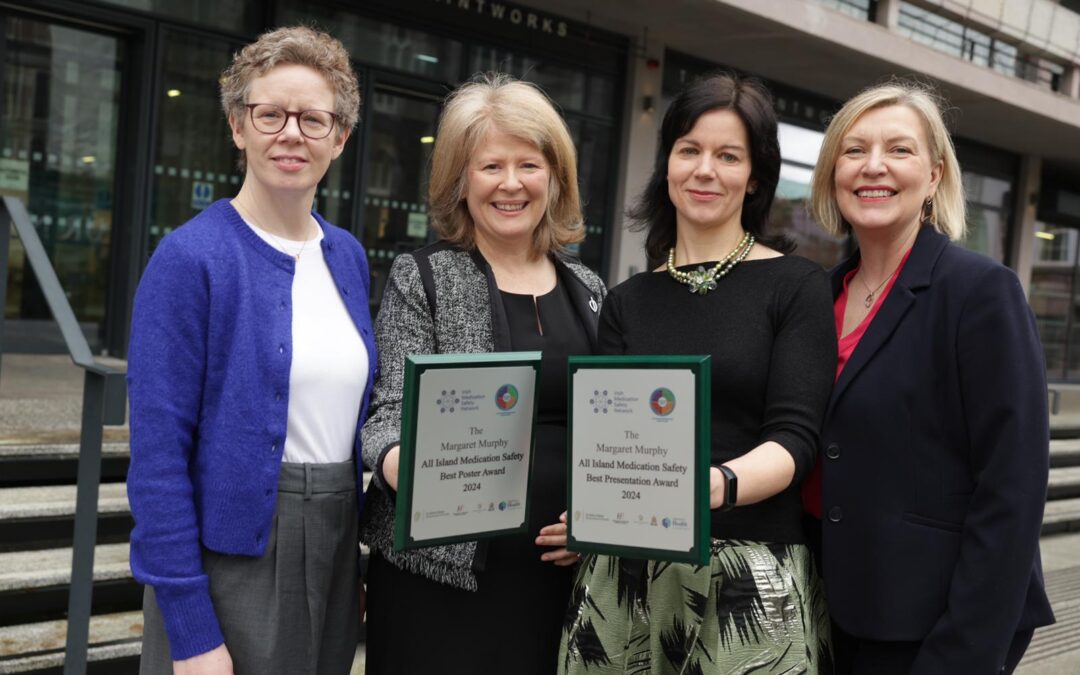
In an unprecedented move to address one of healthcare’s most pressing challenges, Dublin Castle will play host to the first-ever All-Island Medication Safety Conference on 28–29 November 2024. This historic event aims to bridge healthcare practices across...
by IMSN | Nov 17, 2019 | Articles
Insulin is a high risk drug which has the potential to cause serious harm if it is not used correctly.1 Until recently, all insulin available on the European market contained 100 units / mL. A high-strength insulin is one which contains insulin at a concentration of...
by IMSN | Jul 8, 2020 | Articles
The US Institute for Safe Medication Practices considers insulin to be one of the top 5 ‘high-alert’ medications i.e. drugs that bear a heightened risk of causing significant patient harm when they are used in error. IMSN Insulin Best Practice...
by IMSN | Nov 17, 2019 | Articles
Insulin pens (both disposable prefilled pens and reuseable pens) and insulin cartridges are for Single Patient Use only. Risk of Cross-contamination with Insulin Pens This document replaces our original alert which was published in November...

by Oisín Ó hAlmhain | Nov 19, 2025 | conference
The Irish Medication Safety Network (IMSN) is delighted to announce its annual conference for 2025, under the theme “All Grown Up – 18 Years of the IMSN”, will take place on Friday 21 November 2025, at the historic Royal Hospital Kilmainham (D08 FW31), Dublin.This...
by IMSN | Jul 22, 2025 | Articles
Best Practice Guidelines Lithium is indicated for the prophylaxis and treatment of mania, in the prophylaxis of bipolar disorder and as an augmentation strategy for patients with treatment-resistant depression. You can download version 3 (2025) of the IMSN best...
by IMSN | Nov 19, 2019 | Articles
Magnesium sulphate is indicated in the management of pre-eclampsia and also for fetal neuroprotection if there is a risk of preterm delivery. Intravenous magnesium has been repeatedly associated with medication errors internationally and locally. One US...
by IMSN | Nov 21, 2019 | Articles
The Irish Medication Safety Network (IMSN) convened a working group to develop medication incident reporting guidelines. The IMSN guidelines were drafted using the framework developed by the WHO and by building on the systems already in...
by Oisín Ó hAlmhain | Dec 29, 2025 | Uncategorized
Merry Christmas to one and all! Our latest bulletin is now available to download and read: Bulletin7-Dec-2025Download
by IMSN | Aug 6, 2021 | Articles
Methotrexate is a high-risk drug, i.e. serious patient harm can occur as a result of errors involving incorrect frequency (daily rather once weekly), incorrect strength tablets, incorrect strength tablets, or from an adverse drug reaction. Care must be taken with...
by IMSN | Nov 20, 2019 | Articles
Traditionally cancer therapy has involved the use of intravenous products, prepared and administered by specialist staff in hospitals. IMSN Briefing Document on Oral Anticancer Medicines (OAM)
by IMSN | Nov 11, 2024 | Articles
Medicines management is crucial in the care of the patient with Parkinson’s Disease (PD) when they are admitted to hospital, either electively or in an emergency. Missed or delayed doses can impair patients’ swallow, increase their risk of aspiration, render...

by Oisín Ó hAlmhain | Nov 21, 2025 | conference
The following posters were displayed at the Irish Medication Safety Network Conference on 21st November 2025 in IMMA Kilmainham. We thank the authors who have made their work available to us: where an abstract appears as a hyperlink it may be used to view a pdf of the...
by IMSN | Oct 15, 2020 | Articles
Potassium chloride (KCl) is a high-risk medication. The WHO/Joint Commission recommends that health-care organisations have systems and processes in place for the promotion of safe practices with potassium chloride and other concentrated electrolyte solutions. For...
by IMSN | Oct 22, 2024 | Articles
Permanent skin staining can occur with use of parenteral iron if there isextravasation (leakage of fluid) into the surrounding tissues. An increase in reports of iron staining in recent years has been attributed to increased use of intravenous (IV) iron.While skin...
by IMSN | Jun 17, 2024 | Articles
The International Medication Safety Network have published their recommendations for the Global Implementation of Safe Oxytocin Use Practices 2023. The Irish Medication Safety Network contributed to the document and endorse the recommendations.
by IMSN | Nov 19, 2019 | Articles
A number of tools are available to encourage and empower both patients and their caregivers and health care professionals (for example nurses, physicians, pharmacists) to take an active role in...
by IMSN | Sep 17, 2025 | Articles
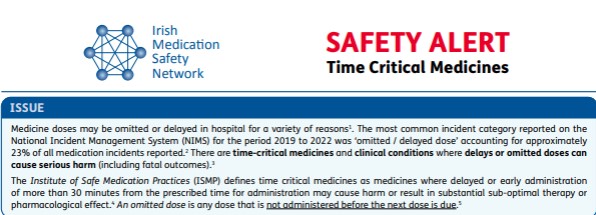
The most common incident reported to the National Incident Management System (NIMS) between 2019 and 2022 were “omitted or delayed dose(s).” There are a variety of reasons why these events might happen in a hospital setting. This alert outlines the issue...
by IMSN | Nov 5, 2024 | Articles
Can you read the following sentence? “it deosn’t mttaer in waht oredr the ltteers in a wrod are the olny iprmoatnt tihng is taht the frist and lsat ltteer are in the rghit pcale” Surprisingly, many people can. This may explain why the following...

by Oisín Ó hAlmhain | Nov 21, 2025 | conference
Niamh O’Hanlon, Chair, IMSN Title: Reflections on 18 Years of the IMSN 1_OHanlonNDownload Prof. Fionnuala Ní Áinle Eve’s Protocol National Guidance on VTE management 2_NiAinle FDownload Claire Browne IMSN Alert on IV Iron Safety (link to the Alert Here)...
by IMSN | Nov 24, 2023 | conference
I am very pleased to be here with you today to recognise the work being done by your organisation and its importance to pharmaceutical healthcare in Ireland. As hospital-based pharmacists, you play a vital role on a daily basis in leading the team that ensures the...
by IMSN | Nov 19, 2019 | Articles
Click here to view the document
by IMSN | Nov 21, 2019 | Articles
The IMSN have updated their guidance on the safe use of IV paracetamol (version 2, Nov 2019) While paracetamol has been used orally for many decades, the introduction of an IV formulation brought new risks, some of which were not experienced with oral and rectal...
by IMSN | Nov 19, 2019 | Articles
Trastuzumab emtansine (Kadcyla) and trastuzumab (e.g. Herceptin) are NOT the same and are NOT interchangeable. Kadcyla is a combination of a monoclonal antibody (trastuzumab) and a cytotoxic agent (emtansine), known as a cytotoxic drug conjugate. IMSN Safety...
by IMSN | Nov 20, 2019 | Articles
The World Health Organisation (WHO) has published guidance in relation to administration of vinca alkaloids via intravenous minibag infusion to avoid accidental death Our previous guidance document on this subject, produced in 2008 and revised in 2010 has...
by IMSN | Apr 2, 2025 | Articles
Parkinson’s disease: Reducing harm from medications (Safety...